
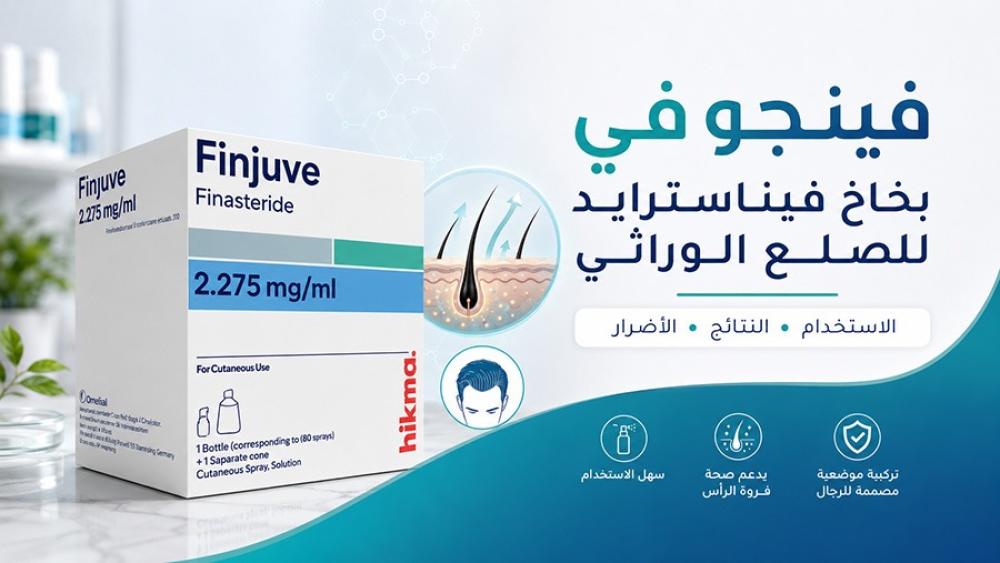
Fingovy Spray is a topical spray containing finasteride and is used by prescription for the treatment of mild to moderate male pattern hair loss in adult men aged 18 to 41 years. It is applied once daily at a dose ranging from 1 to 4 sprays depending on the size of the affected area, and clear evidence of hair growth may take around 3 to 6 months to appear.
Topical finasteride spray for male pattern hair loss differs from shampoos and general hair-care products because it targets one of the hormonal factors associated with shrinking hair follicles in men with androgenetic alopecia.
However, using Fingovy topically does not mean that it is suitable for every type of hair loss or that it is completely free of side effects. The cause of hair loss should therefore be diagnosed, and the dose prescribed by the doctor should be followed.
In this guide, we explain what Fingovy Topical Finasteride Spray for Male Pattern Hair Loss – 180 Sprays is, how it works, who it is intended for, how many sprays are used, how long the bottle lasts, when results may appear, possible side effects, and how it differs from minoxidil and oral finasteride.
Fingovy Spray at a Glance
- Active ingredient: Topical finasteride 2.275 mg/ml.
- Use: Mild to moderate male pattern hair loss in men.
- Registered age group: Men aged 18 to 41 years.
- Dose: 1 to 4 sprays once daily depending on the size of the balding area.
- Maximum dose: 4 sprays per day.
- Bottle capacity: 180 sprays.
- When results may appear: Usually around 3 to 6 months.
- Dispensing: Prescription medicine.
- Use in women: The product is not intended for women.
What Is Fingovy Spray?
Fingovy is a topical solution sprayed directly onto areas of baldness or thinning hair on the scalp. The bottle includes a pump and a cone-shaped applicator that helps direct the dose to the intended area and reduce the spread of spray into the air.
Each ml of solution contains 2.275 mg of finasteride. The pump delivers approximately 50 microliters with each spray, equivalent to about 114 micrograms of the active ingredient.
The bottle contains 180 sprays, and the number of days it lasts depends on the number of daily sprays prescribed by the doctor.
Fingovy is a prescription medicine, not a general cosmetic hair spray that can be used for every cause of hair loss.
Who Is Fingovy Used For?
Fingovy is used for the topical treatment of mild to moderate male pattern hair loss in men aged 18 to 41 years, with the aim of increasing hair growth and reducing continued hair loss.
Male pattern hair loss may be more likely when hair loss develops gradually in patterns such as:
- Recession of the hairline on both sides of the forehead.
- Reduced hair density at the crown.
- Gradual thinning of the hair over months or years.
- Hair in affected areas becoming shorter and finer.
- A family history of male pattern hair loss.
Diagnosis should not rely on the pattern of hair loss alone. A doctor may need to examine the scalp or request tests when another cause is suspected.
When Is Fingovy Not the Appropriate Treatment?
Topical finasteride spray should not automatically be used for every type of hair loss. A different medical evaluation may be needed when there is:
- Sudden or severe hair loss over a short period.
- Round patches or clearly defined bald spots.
- Diffuse hair loss affecting the entire scalp evenly.
- Severe itching, scaling, pain, or inflammation.
- Hair loss that started after a serious illness or surgery.
- A restrictive diet or rapid weight loss.
- Suspected iron deficiency or thyroid disorder.
- Use of a medication that may cause hair loss.
- A smooth, completely bald area that has been present for many years.
Finasteride does not treat vitamin deficiencies, autoimmune alopecia, or scalp diseases. Using it without a diagnosis may delay identification of the real cause of hair loss.
How Does Topical Finasteride Work on Hair?
Finasteride inhibits type II 5-alpha reductase, an enzyme that helps convert testosterone into dihydrotestosterone, or DHT.
DHT is associated with male pattern hair loss in genetically predisposed men. Over time, it may contribute to:
- Shrinking of hair follicles.
- Shortening of the hair growth phase.
- Production of weaker and finer hairs.
- More noticeable thinning at the front of the scalp and crown.
- Progressive reduction in hair density.
Topical finasteride helps reduce the effect of DHT within the scalp, which may slow follicle miniaturization and help preserve existing hair and improve hair growth in people who respond to treatment.
Does Fingovy Permanently Cure Male Pattern Hair Loss?
No. Fingovy does not permanently remove the genetic tendency toward male pattern hair loss and does not guarantee restoration of all follicles that stopped producing hair years ago.
Realistic treatment goals include:
- Reducing continued hair loss.
- Preserving existing hair as much as possible.
- Improving density in some responsive areas.
- Slowing the progression of male pattern hair loss.
The chance of benefit is usually better when treatment starts at an early or moderate stage, before an area becomes completely smooth and bald.
How to Use Fingovy Spray
Fingovy is used once daily on completely dry hair and scalp, according to the number of sprays prescribed by the doctor based on the size of the affected area.
- Make sure the hair and scalp are completely dry.
- Attach the cone provided with the bottle to the pump.
- Before the first use, prime the pump by pressing it fully 4 times toward a sink, then rinse the sink.
- Place the cone directly over the bald or thinning area.
- Press the pump fully once to deliver one spray.
- If more than one spray has been prescribed, move the cone to an adjacent, non-overlapping area.
- Do not spray the solution into the air or toward the face.
- Do not touch the solution with your hands or massage it with your fingers.
- Allow the solution to dry before wearing a hat or helmet or before the scalp touches a pillow.
- Leave the solution on the scalp for at least 6 hours.
If the bottle has not been used for 2 weeks or longer, the pump should be re-primed with one full press before the next dose.
How Many Sprays of Fingovy Are Used Each Day?
The official dose ranges from 1 to 4 sprays once daily, depending on the size of the balding area.
- One spray may be sufficient for a small area.
- The doctor may prescribe 2 or 3 sprays for larger areas.
- The maximum is 4 sprays per day.
- Areas receiving the sprays should not overlap.
- Do not use an extra dose to make up for a missed dose.
- Do not increase the dose in an attempt to get faster results.
There is no single fixed dose that is suitable for every user. The number of sprays depends on the size of the area requiring treatment, not on how worried someone is about hair loss.
How Long Does a 180-Spray Fingovy Bottle Last?
The duration of the bottle depends on the number of sprays used each day:
- 1 spray daily: Approximately 180 days.
- 2 sprays daily: Approximately 90 days.
- 3 sprays daily: Approximately 60 days.
- 4 sprays daily: Approximately 45 days.
Do not use the bottle after all 180 sprays have been delivered, even if some solution appears to remain inside, because the pump may no longer deliver a complete dose.
The bottle should also not be used more than 6 months after it has been opened.
When Do Fingovy Spray Results Appear?
Clear evidence of hair growth usually requires around 3 to 6 months of regular daily use.
The speed and degree of response may vary according to:
- The stage of male pattern hair loss.
- How long the thinning has been present.
- The location of the affected area.
- The condition of the hair follicles.
- Adherence to the daily dose.
- The presence of other causes of hair loss.
A response may appear as:
- Reduced hair shedding.
- Stabilization of the widening thinning area.
- Appearance of short, fine hairs in some areas.
- Gradual improvement in crown density.
- Slower recession of the hairline.
Treatment should not be considered a failure after only a few weeks, and the number of sprays should not be increased if results are slow to appear.
What Do Studies Say About Topical Finasteride?
In a randomized clinical study lasting 24 weeks and involving men with male pattern hair loss, topical finasteride produced a greater increase in hair count within the measured area compared with the inactive solution.
The average change after 24 weeks was approximately 20.2 hairs in the topical finasteride group, compared with 6.7 hairs in the inactive-solution group.
Differences favoring topical finasteride appeared from week 12, and the average numerical improvement was close to that seen in the oral finasteride group by the end of the study.
These results represent averages from a clinical study and do not guarantee that every user will achieve the same number of additional hairs or the same degree of improvement.
Can Fingovy Regrow Hair at the Front of the Scalp?
Fingovy may help reduce hair loss and improve growth in areas that still contain follicles capable of responding, but restoration of the frontal hairline is not guaranteed.
The crown may show clearer improvement in some men, while response at the front of the scalp and hairline may be more variable.
The chance of response is lower when the area has been completely smooth and bald for a long time because treatment cannot restore follicles that are no longer capable of producing hair.
Is Fingovy Spray Safer Than Finasteride Tablets?
Topical finasteride reaches the bloodstream in a much smaller amount than oral tablets, but it does not remain completely confined to the scalp.
In the clinical study, the highest blood concentration of finasteride was more than 100 times lower with the topical formulation compared with oral tablets.
Average blood DHT levels decreased by approximately 34.5% with topical finasteride, compared with 55.6% with oral finasteride.
These results indicate lower systemic exposure and a potentially lower likelihood of some effects associated with reducing DHT in the bloodstream, but they do not mean that the spray is completely free of risk.
The doctor determines the more appropriate form according to the degree of hair loss, medical history, previous response, and the possibility of side effects.
Fingovy Spray Side Effects and Possible Risks
Fingovy may cause side effects, although they do not occur in every user.
Local treatment-related effects reported in the main study included:
- Scalp itching.
- Scalp redness.
- Irritation or a burning sensation, especially on broken or inflamed skin.
Treatment-related sexual adverse events were reported in:
- 2.8% of the topical finasteride group.
- 3.3% of the inactive-solution group.
- 4.8% of the oral finasteride group.
No important differences were found between topical finasteride and the inactive solution on the sexual-function questionnaire at weeks 12 and 24.
These percentages do not mean that the risk is absent and cannot predict how an individual person will respond. Inform your doctor if you develop sexual symptoms or any unusual symptoms.
When Should Fingovy Be Stopped and Medical Help Sought?
Stop using the product and seek medical advice if you develop:
- Swelling of the face, lips, or tongue.
- Difficulty breathing.
- A skin rash or severe allergic reaction.
- Severe or persistent scalp irritation or burning.
- Pain, swelling, or an unusual change in breast tissue.
- New, persistent, or bothersome sexual symptoms.
- Palpitations or other unusual symptoms after use.
Can Women Use Fingovy?
No. Fingovy is not intended for use by women and must not be used during pregnancy or when pregnancy is possible.
Absorption of finasteride through the skin of a pregnant woman may affect the development of the genital organs of a male fetus.
Women who are pregnant or may become pregnant should:
- Not use the product.
- Not touch the solution.
- Avoid touching the treated scalp before it has dried.
- Avoid touching surfaces contaminated with the solution.
- Wash the skin thoroughly after accidental contact.
- Seek medical advice if exposure occurs during pregnancy.
Fingovy vs Minoxidil: What Is the Difference?
Fingovy and minoxidil are not identical alternatives because each works through a different mechanism.
- Fingovy: Contains finasteride and reduces the effect of DHT associated with shrinking hair follicles.
- Minoxidil: Helps stimulate hair follicles and prolong the hair growth phase through a different mechanism.
A doctor may prescribe one of the treatments or create a plan that includes both in some cases. However, the two products should not be applied at the same time or on the same area without clear instructions.
There have not been sufficient interaction studies of Fingovy with all other topical scalp products, and combining products randomly may increase scalp irritation or make it difficult to identify the cause of symptoms.
Products Related to Hair Loss Treatment or Care
Fingovy Topical Finasteride Spray – 180 Sprays
Fingovy Topical Finasteride Spray is a prescription medicine intended for mild to moderate male pattern hair loss in men aged 18 to 41 years.
Avalon Avogain Minoxidil 5% for Men
Avalon Avogain Minoxidil 5% Solution for Male Pattern Hair Loss – 50 ml contains minoxidil and works through a different mechanism from finasteride.
Avogain is not an identical substitute for Fingovy, and the two products should not be combined without guidance from a doctor or pharmacist.
ACM Novophane Lotion for Hair Loss Care
ACM Novophane Lotion for Hair Loss Care – 100 ml is a hair and scalp care product, but it does not target DHT and is not a medicinal substitute for Fingovy.
Not all products may be available at all times, so the product page should be checked for current availability.
You can also read our article on Best Hair Products in Saudi Arabia to learn more about the differences between general hair-care products and products used to treat hair loss.
Important Precautions Before Using Fingovy
- Use the product only after male pattern hair loss has been diagnosed.
- Tell your doctor if you are using finasteride or dutasteride in any other form.
- Tell your doctor about all medicines and products used on the scalp.
- Do not use it on broken or inflamed skin.
- Do not use more than 4 sprays per day.
- Do not spray the solution toward the face or eyes.
- Wash any area that accidentally comes into contact with the solution.
- Tell your doctor that you are using finasteride before having a prostate-specific antigen, or PSA, test.
- Keep the product away from children and pregnant women.
- Allow the solution to dry before contact with a pillow or hat.
- Do not use a hair dryer, open flame, or cigarettes near the solution before it has dried.
How to Store Fingovy
- Store below 30°C.
- Keep it in the original packaging.
- Keep it out of the reach of children.
- Keep it away from flames, heat, and smoking because it contains alcohol.
- Do not use after the expiry date.
- Do not use more than 6 months after opening.
- Do not use the bottle after all 180 sprays have been delivered.
Common Mistakes When Using Fingovy Spray
- Using it without confirming that the hair loss is hereditary.
- Spraying the product onto the hair instead of the scalp.
- Applying it to a wet scalp.
- Using another person’s fixed dose.
- Exceeding 4 sprays per day.
- Applying sprays over the same area so they overlap.
- Touching the solution with the hands and massaging it in.
- Washing the hair before 6 hours have passed.
- Allowing the scalp to touch a pillow or hat before the product has dried.
- Combining it randomly with minoxidil.
- Stopping after a few weeks because results have not appeared quickly.
- Ignoring side effects or failing to tell the doctor about them.
- Allowing children or pregnant women to touch the treated area.
When Should You See a Dermatologist?
- If hair loss is sudden or severe.
- If round or clearly defined bald patches appear.
- If there is inflammation, pain, or severe scaling.
- If you are not sure about the cause of hair loss.
- If side effects develop during treatment.
- If there is no response after the period specified by the doctor.
- If you use other medicines or have chronic medical conditions.
- Before combining Fingovy with minoxidil.
Frequently Asked Questions
What Is Fingovy Spray?
It is a spray containing finasteride at a concentration of 2.275 mg/ml and is used by prescription to treat mild to moderate male pattern hair loss in men aged 18 to 41 years.
How Many Sprays of Fingovy Are Used Daily?
The dose ranges from 1 to 4 sprays once daily depending on the size of the balding area and the doctor’s instructions. Do not exceed 4 sprays in one day.
When Do Fingovy Results Start to Appear?
Clear evidence of hair growth may require 3 to 6 months of regular use. Results vary according to the stage of hair loss and the condition of the follicles.
Can Fingovy Regrow Hair?
It may help increase hair growth and reduce continued hair loss in men with mild to moderate male pattern hair loss, but it does not guarantee restoration of every bald area.
Can Fingovy Cause Erectile Dysfunction?
Sexual symptoms can occur with topical finasteride, but they were uncommon in the main study and did not exceed the rate reported with the inactive solution. Contact your doctor if persistent or bothersome symptoms develop.
Is Fingovy Suitable for Women?
No. The product is not intended for women. Pregnant women or women who may become pregnant should avoid contact with the solution or with the treated scalp before it has dried.
Does Fingovy Require a Prescription?
Yes. Fingovy is registered as a prescription medicine.
Can Fingovy Be Used With Minoxidil?
A doctor may prescribe both treatments as part of one plan in some cases, but they should not be combined or applied to the scalp randomly.
Should Fingovy Be Massaged In After Spraying?
No. The directions for use specify placing the cone directly on the scalp and spraying the dose without touching the solution with the hands.
Should You Wash Your Hair After Using Fingovy?
The solution should remain on the scalp for at least 6 hours before the hair is washed.
What Should I Do If I Miss a Dose?
Do not use a double dose. Use the next dose at the usual time according to your doctor’s instructions.
Can I Increase the Number of Sprays to Get Faster Results?
No. Increasing the dose does not speed up hair growth and may increase the risk of side effects. The maximum is 4 sprays per day.
How Long Does One Fingovy Bottle Last?
A bottle may last from approximately 45 to 180 days depending on the number of daily sprays. It lasts around 45 days when using 4 sprays per day and around 180 days when using 1 spray per day.
Conclusion
Fingovy Finasteride Spray is a topical prescription treatment that targets the effect of DHT associated with shrinking hair follicles in male pattern hair loss.
It is used in men aged 18 to 41 years with mild to moderate male pattern hair loss at a dose of 1 to 4 sprays once daily depending on the size of the affected area and the doctor’s instructions.
Results may take around 3 to 6 months to become apparent, and topical application does not mean that the medicine cannot enter the bloodstream or that side effects are impossible.
Do not use Fingovy for any type of hair loss without a diagnosis, and do not combine it with minoxidil or other topical scalp products without a clear plan from a doctor or pharmacist.
Medical warning: Fingovy is a prescription medicine. The information provided here is for general educational purposes and does not replace consultation with a doctor or pharmacist or reading the patient information leaflet supplied with the product.