
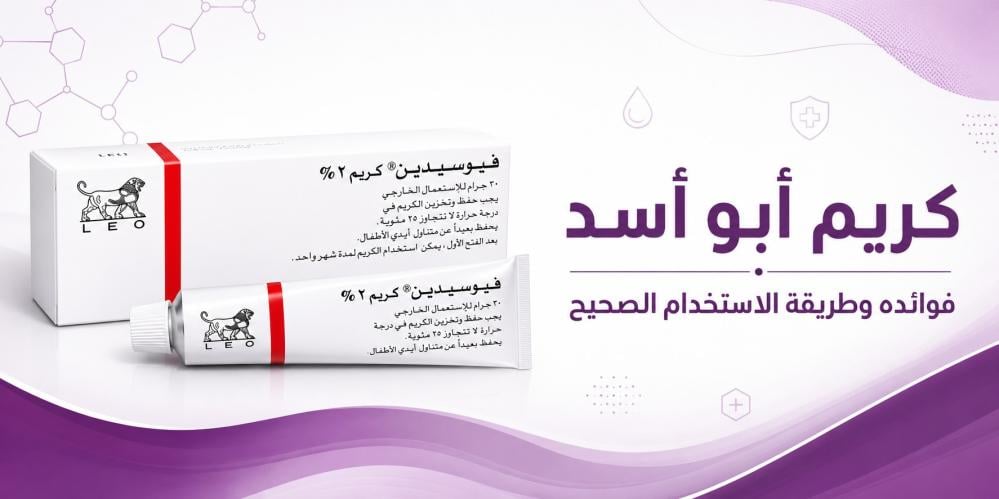
Many people in Saudi Arabia search for Abu Asad Cream when they develop inflamed spots, minor scratches, or redness accompanied by signs of skin inflammation. The popular name “Abu Asad” usually refers to Fucidin Cream, known for its distinctive packaging.
However, it is important to understand that this cream is not an ordinary cosmetic product. It is a topical antibiotic that is generally used for certain bacterial skin infections, which means it is not suitable for every case of itching, redness or skin irritation.
What Is Abu Asad Cream?
Abu Asad Cream is the commonly used name for Fucidin Cream. It is a topical cream that usually contains an active ingredient called fusidic acid.
Fusidic acid is a topical antibiotic that helps fight certain types of bacteria responsible for skin infections.
Abu Asad Cream is generally used when a superficial bacterial infection is suspected, such as certain infected wounds, infected scratches, or inflamed spots surrounded by noticeable redness or mild discharge.
However, it should not be considered a general treatment for every skin problem. Skin irritation may be caused by fungal infections, allergies, viral infections or ordinary acne.
If you are looking for the product through an online pharmacy, you can review the original Abu Asad Cream product page for the available product details. Availability and price may vary according to the city, neighbourhood, time of order and pharmacy policy.
Common Uses of Abu Asad Cream
Abu Asad Cream may help in some superficial bacterial skin infections, particularly when the problem is limited to a small area of skin.
Uses that a doctor or pharmacist may recommend in certain situations include:
- Small wounds and scratches affected by a bacterial infection.
- Some inflamed spots showing signs of infection.
- Skin inflammation accompanied by a secondary bacterial infection.
- Impetigo in some cases after professional assessment.
- Limited superficial infections around hair follicles.
These uses do not mean that the cream is suitable for every condition that looks similar.
Fungal infections, allergies, eczema and acne may sometimes resemble bacterial skin inflammation, which is why asking a pharmacist or doctor before use can be important.
Potential Benefits of Abu Asad Cream
The main benefit of Abu Asad Cream is that it may help reduce the activity of certain bacteria on the skin when it is used for an appropriate condition.
It may therefore help reduce superficial bacterial inflammation and support improvement in the appearance of the affected skin when the problem is genuinely caused by a bacterial infection.
Potential benefits when used correctly include:
- Helps fight certain types of skin bacteria.
- May reduce signs of superficial bacterial inflammation.
- Can be applied locally to a limited area rather than using a systemic treatment in some minor cases.
- May be suitable for small infected wounds and scratches when recommended by a healthcare professional.
However, there is no real benefit in using it when the problem is fungal, allergic or simply irritation without infection.
Unnecessary use of topical antibiotics may also reduce their future effectiveness and increase the risk of bacterial resistance.
What Is the Difference Between Abu Asad Cream and Fucidin Cream?
In everyday use, Abu Asad Cream is usually the popular name for Fucidin Cream. Therefore, when someone searches for Abu Asad Cream, they are generally looking for the product known as Fucidin.
Fucidin Cream contains a topical antibiotic and differs from some other creams that may contain corticosteroids or additional active ingredients.
When buying the product, do not rely only on the colour of the package or its popular nickname. Check the product name, active ingredient and dosage form.
You can review the Fucidin Cream product page for available product details, while following the advice of your doctor or pharmacist before use, especially when the product is intended for children, the face or a sensitive area.
What Is the Difference Between Fucidin Cream and Fucicort Cream?
One of the most common mistakes is confusing Fucidin Cream with Fucicort Cream. The difference between the two is important because each product has a different type of use.
Fucidin Cream
Fucidin usually contains only a topical antibiotic, fusidic acid. It is generally used for certain superficial bacterial skin infections when appropriate.
Fucicort Cream
Fucicort contains a topical antibiotic combined with a corticosteroid.
The presence of a corticosteroid makes it very different from Fucidin. It may help reduce redness, itching and inflammation, but it is not suitable for random or prolonged use, particularly on the face, around the eyes or on sensitive areas.
For this reason, you should not replace Fucidin with Fucicort on your own.
Fucicort may be appropriate for certain inflammatory skin conditions accompanied by infection, but its use requires clear medical or pharmaceutical guidance.
How to Use Abu Asad Cream Correctly
Directions may vary depending on the condition, so general instructions should not replace the advice of your doctor or pharmacist.
However, some basic steps can help support safer use.
General Application Steps
- Wash your hands thoroughly before applying the cream.
- Gently clean the affected area and dry it without vigorous rubbing.
- Apply a thin layer of cream only to the affected area.
- Avoid applying it to large areas without medical advice.
- Do not apply it inside the eyes, mouth or nose.
- Wash your hands after use unless the hands themselves are being treated.
- Do not share the cream with another person, even if their symptoms look similar.
Do not increase the amount or frequency of application on your own because you believe it will speed up improvement.
Using more than necessary does not mean better results and may cause irritation or unnecessary exposure to a topical antibiotic.
Can Abu Asad Cream Be Used for Pimples?
Abu Asad Cream may be used for some inflamed spots if they are accompanied by a superficial bacterial infection, but this does not make it a primary treatment for acne.
Acne has several possible contributing factors, including blocked pores, increased oil production, hormonal factors and inflammation.
Applying a topical antibiotic to every facial spot without assessment may not be helpful, particularly when acne is recurrent or widespread.
In this situation, it is better to consult a dermatologist or pharmacist to choose a suitable routine according to your skin type and the severity of the condition.
Can Abu Asad Cream Be Used on the Face?
Abu Asad Cream may be used on the face only in specific situations and after professional guidance because facial skin can be more sensitive than other areas of the body.
Avoid applying it around the eyes or lips or across large areas of the face without professional advice.
If facial redness is caused by allergy, rosacea, fungal infection, irritation from a cosmetic product or non-bacterial acne, Abu Asad Cream may not be the correct choice.
Fucicort Cream requires even greater caution when used on the face because it contains a topical corticosteroid.
Is Abu Asad Cream Suitable for Children?
It may be used in children for certain bacterial skin conditions when recommended by a doctor or pharmacist.
However, it should not be used in children simply because it worked in a previous situation or because another person recommended it.
Children's skin is sensitive, and bacterial infections, allergies, fungal infections and skin irritation can sometimes look similar.
A doctor should be consulted if the child is very young, if the affected area is widespread, or if there is obvious pus, fever, severe pain, swelling or a rash close to the eye.
When Should Abu Asad Cream Not Be Used?
Abu Asad Cream should generally not be used in the following situations without professional advice:
- Known allergy to fusidic acid or any ingredient in the cream.
- Fungal skin infections such as ringworm or athlete's foot.
- Itching without signs of bacterial infection.
- Widespread or recurrent acne without assessment.
- Deep wounds or major burns.
- Infections close to the eye.
- Repeated or prolonged use.
- Pregnancy or breastfeeding without medical advice.
These points do not mean that the cream is dangerous when used correctly. They highlight that treatment should be selected according to the cause of the skin problem rather than its appearance alone.
When Should You Consult a Doctor?
Consult a doctor or pharmacist if the condition does not improve within the period you were advised to use the treatment, or if redness, swelling or pain becomes worse or discharge and pus develop.
You should also seek advice when the affected area is on the face, around the eye, in a sensitive area or involves a child.
Medical advice is also particularly important for people with diabetes, weakened immunity, pregnant or breastfeeding women, or people with chronic skin conditions such as eczema or psoriasis.
In these situations, choosing the wrong cream may delay appropriate treatment.
Tips Before Buying Abu Asad Cream Online in Saudi Arabia
When buying Abu Asad Cream online in Saudi Arabia, it is best to make sure you are purchasing from a trusted pharmacy and that the product information is clearly displayed.
Do not rely only on the popular name or the appearance of the packaging, because several products may have similar names or different formulations.
Before purchasing, consider the following:
- Check the product name and active ingredient.
- Check the dosage form: cream, ointment or another formulation.
- Do not choose Fucicort instead of Fucidin without a clear reason.
- Check the expiry date when you receive the product.
- Do not choose a pharmacy based only on price.
- Ask a pharmacist if you are unsure whether the product is suitable for your condition.
Delivery times may vary between Riyadh, Jeddah, Dammam, Makkah, Madinah and other cities in Saudi Arabia depending on the neighbourhood, order time and product availability.
Prices and stock can also change, so it is best to review the product page at the time of purchase.
Frequently Asked Questions
Is Abu Asad Cream the Same as Fucidin?
Yes. Abu Asad Cream commonly refers to Fucidin Cream because of its well-known packaging and branding.
However, when purchasing, always confirm the product name and active ingredient.
Does Abu Asad Cream Treat Fungal Infections?
No. Abu Asad Cream is not an antifungal treatment.
If the condition is caused by a fungal infection, you may need an antifungal cream selected by a doctor or pharmacist.
Can Abu Asad Cream Be Used for Acne?
It may not be suitable for every type of acne.
It may help in certain inflamed spots affected by a superficial bacterial infection, but it is not a general treatment for recurrent or widespread acne.
What Is the Difference Between Fucicort Cream and Fucidin Cream?
Fucidin Cream usually contains a topical antibiotic only, while Fucicort contains an antibiotic combined with a topical corticosteroid.
For this reason, Fucicort requires greater caution during use.
Can Abu Asad Cream Be Used for Children?
It may be used in children in certain situations when recommended by a doctor or pharmacist, but random use is not recommended because children's skin is sensitive and different skin conditions can produce similar symptoms.
Does Abu Asad Cream Require a Prescription?
Dispensing rules may vary according to local regulations and pharmacy policy.
Because it is a topical antibiotic, it is best to consult a doctor or pharmacist before use, particularly for recurrent or sensitive conditions.
Conclusion
Abu Asad Cream is the popular name commonly used for Fucidin Cream, a topical antibiotic that may help treat certain superficial bacterial skin infections.
Correct use depends on identifying the cause of the skin problem because the cream does not treat fungal infections, allergies or every type of acne.
It is also important to distinguish it from Fucicort Cream because Fucicort contains a topical corticosteroid and requires greater caution.